Dual Diagnosis Treatment Scottsdale: Co-Occurring Disorders in Arizona

Green and white poster featuring a tree and the text "PURPOSE HEALING CENTER

Dual diagnosis rehab at Purpose Healing Center in Arizona treats co-occurring substance use and mental health disorders simultaneously. The center’s 30-, 60-, or 90-day programs provide evidence-based therapies, including psychotherapy and behavioral therapy, to address both conditions. Purpose Healing Center accepts AHCCCS and many private insurance plans for accessible care.

What Is a Dual Diagnosis?

A dual diagnosis identifies the presence of both a substance use disorder and a mental health disorder in one person. This condition, also called a co-occurring disorder rehab AZ facility treats, affects thousands of Arizona residents each year. Without integrated care, untreated mental health symptoms often trigger relapse. The cycle continues until both conditions receive simultaneous attention.

Co-occurring disorders happen when someone experiences both a substance use disorder and a mental health condition simultaneously. Common combinations include alcohol addiction paired with depression, opioid use alongside anxiety disorders, and stimulant dependence co-occurring with PTSD. Arizona treatment providers see these patterns daily.

Why Does Integrated Treatment Matter for Co-Occurring Disorders?

The National Institute on Drug Abuse (NIDA) recommends addressing both conditions as part of treatment rather than treating them separately. Research suggests an integrated approach leads to better outcomes. Treating addiction while ignoring underlying trauma or mood disorders leaves the root cause untouched. Fragmented care increases the risk of returning to substance use.

What Conditions Appear Together Most Often?

Dual diagnosis treatment in Arizona programs encounter several recurring combinations. Depression and alcoholism frequently appear together. Anxiety disorders accompany benzodiazepine or alcohol dependence. PTSD and opioid use disorder form another common pairing. Mental health and addiction care in Arizona providers also treat bipolar disorder alongside stimulant addiction. Each combination demands a tailored treatment plan.

Integrated psychiatric support forms the foundation of effective dual diagnosis care. Arizona residents seeking recovery benefit from programs that coordinate psychiatric medication management with addiction counseling. This unified model stabilizes mood while building sobriety skills. The result is a treatment experience that heals the whole person rather than isolated symptoms.

v5 71970 section 1 inline

Why Treat Both Conditions Together?

Treating only one condition when addiction and mental health struggles exist side by side leads to incomplete recovery. A person with alcohol use disorder may also experience depression, and the symptoms of each condition can affect the other. Without addressing both simultaneously, the untreated disorder continues fueling the cycle of substance use. Recovery.com notes that a person with alcohol use disorder may also experience depression. The symptoms of each condition can affect the other. This interconnection means that ignoring mental health while treating addiction prevents full healing.

How do co-occurring disorders interact?

Mental health symptoms often drive substance use as a form of self-medication. Anxiety, depression, or trauma-related distress can intensify cravings and make relapse more likely. At the same time, substance use worsens psychiatric symptoms over time. The two conditions reinforce each other in a loop that single-focus treatment cannot break.

What happens when only addiction is treated?
Treating only alcohol use while ignoring mental health means a person could never fully heal. The underlying psychological pain remains active, creating constant pressure to return to substances for relief. Arizona treatment providers recognize that fragmented care leaves clients vulnerable to repeated relapse. Integrated treatment addresses both conditions together, giving individuals a realistic path to lasting stability.

Dual diagnosis treatment in Arizona programs and co-occurring disorder rehab AZ facilities use this integrated model. Mental health and addiction care in Arizona services combine psychiatric support with substance use treatment. Integrated psychiatric support ensures that therapy, medication management, and recovery planning work as one coordinated effort rather than separate, disconnected services.

v5 71970 section 2 inline

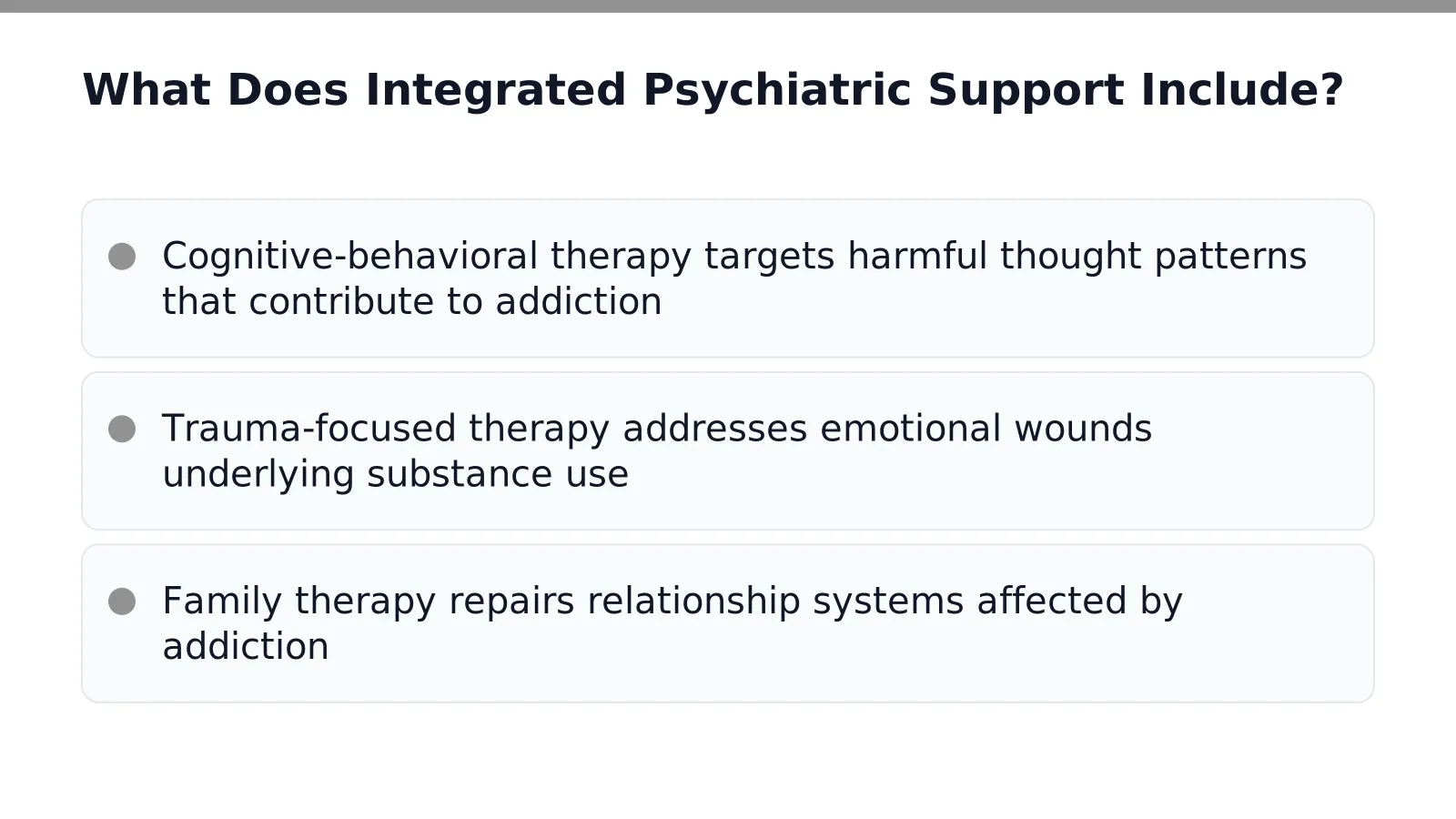
What Does Integrated Psychiatric Support Include?

Integrated psychiatric support combines addiction treatment with mental health care in a single, coordinated plan. Purpose Healing Center delivers this model through evidence-based and holistic approaches tailored to each client’s needs across Arizona.

The center’s clinical team addresses both substance use and underlying psychiatric conditions simultaneously. This dual focus prevents the common failure pattern where untreated depression, anxiety, or trauma drives a return to substance use.

What Therapies Are Used in Integrated Psychiatric Support?

Purpose Healing Center offers several structured therapies within its integrated model:

  • Cognitive-behavioral therapy targets harmful thought patterns that contribute to addiction
  • Trauma-focused therapy addresses emotional wounds underlying substance use
  • Family therapy repairs relationship systems affected by addiction

Psychotherapy and behavioral therapy help patients change the harmful thoughts and behaviors that initially led to alcohol or drug addiction. Each therapy addresses both physical and emotional aspects of recovery.

How Does Integrated Care Differ from Treating One Condition Alone?

Treating only addiction while ignoring co-occurring mental health symptoms leaves the root cause unaddressed. Purpose Healing Center’s co-occurring disorder rehab AZ programs recognize that substance use and psychiatric conditions reinforce each other.

The center’s dual diagnosis treatment in Arizona locations provide comprehensive care that manages both conditions concurrently. Clients receive integrated psychiatric support through every level of care, from detox through outpatient programming.

Mental health and addiction care in Arizona services at Purpose Healing Center follow the same integrated framework. The treatment team coordinates psychiatric and addiction interventions rather than delivering them as separate, disconnected services.

How Does Medical Detox Fit Into Care?

Medical detox serves as the critical first step in dual diagnosis treatment in Arizona programs. A medically supervised detox setting is almost always used as a precursor to other addiction treatment services, like inpatient or outpatient drug rehab. Without this foundation, the rest of the recovery plan cannot begin safely.

Attempting to stop substances without medical oversight carries real risks. Getting off substances on one’s own can be dangerous in some instances due to withdrawal symptoms, which can be severe. For individuals entering co-occurring disorder rehab AZ programs, unmanaged withdrawal complicates both substance use and underlying mental health conditions.

What Happens During Medical Detox?

The detox program helps clients facing alcohol or drug addiction stop using substances safely with the care and supervision of medical professionals. This structured environment allows the clinical team to monitor vital signs and respond to complications as they emerge.

  • Medical supervision around the clock during the acute withdrawal phase
  • Stabilization before transitioning into residential or outpatient programming
  • Assessment of co-occurring mental health symptoms that surface once substances clear

How Long Does Detox Typically Last?

Detox usually lasts for 1 to 2 weeks. The exact duration depends on the substance, the severity of dependence, and the individual’s overall health. Clients then step down into the next level of care, which may include mental health and addiction care in Arizona services or integrated psychiatric support within a structured treatment plan.

Medical detox is not a standalone solution. It prepares clients for the therapeutic work ahead, where behavioral therapies and psychiatric care address the root causes of addiction.

How Do You Find Dual Diagnosis Rehab in Arizona?

Finding effective dual diagnosis treatment in Arizona starts with verifying a facility’s clinical credentials and integrated care model. The most reliable programs hold Joint Commission accreditation and treat substance use disorders alongside mental health conditions within a single, coordinated plan. Facilities lacking this integrated approach leave underlying psychiatric symptoms unaddressed, which raises the risk of relapse and prolongs suffering.

What Credentials Should an Arizona Dual Diagnosis Program Have?

Joint Commission accreditation signals that a facility meets rigorous safety and quality standards. Purpose Healing Center operates accredited locations in Arizona, providing a structured environment for individuals facing both substance abuse and co-occurring mental health issues. This credential confirms that clinical protocols, staff qualifications, and patient care systems undergo regular external review.

How Does the Intake Process Work at a Co-Occurring Disorder Rehab?

A thorough intake assessment shapes the entire treatment trajectory. Before entering any program at Purpose Healing Center, staff members conduct a free intake assessment designed to map each person’s specific symptoms and treatment needs. Skipping this step often results in a mismatched level of care. The assessment guides placement into the appropriate starting point, whether medical detox, residential care, or outpatient services.

Co-occurring disorder rehab in AZ becomes more accessible when insurance coverage aligns with clinical needs. Purpose Healing Center accepts AHCCCS plans and many private health insurance policies, removing a common financial barrier for Arizona residents. Verifying benefits early in the search process prevents delays. The combination of accredited facilities, integrated mental health and addiction care in Arizona, and integrated psychiatric support creates a treatment pathway that addresses the full scope of dual diagnosis rather than isolating one condition from the other.

Conclusion

Choosing a dual diagnosis program in Arizona requires verifying that the facility treats both conditions within one coordinated plan, holds Joint Commission accreditation, and begins with a thorough intake assessment. Purpose Healing Center meets these criteria through its integrated psychiatric support and medical detox services across Arizona. Taking the next step starts with confirming insurance coverage and scheduling that free intake assessment, which determines the appropriate level of care for lasting recovery.

Written and Reviewed by